Manage agent access
Admins have granular control over how users can share agents. They determine how much agent access an audience gets on a per-agent basis.
Have the Admin role to manage agent access. See About Role Based Access Control (RBAC) for more information.
Agent access tiers
When someone shares an agent with an audience, they can give the audience different levels of access. Each agent has one owner. Only the current owner, Agent Moderators, and Admins can transfer ownership.
By default, unshared agents are only visible to Admins, agent moderators, and the agent creator.
The following table shows capabilities that each level of access grants.
| Level of access to agent | Can see agent in library | Can run agent | Can edit agent | Can delete agent |
|---|---|---|---|---|
| Not in sharing audience | No | No | No | No |
| Viewer | Yes | Yes | No | No |
| Editor | Yes | Yes | Yes | No |
| Owner | Yes | Yes | Yes | Yes |
Agent roles
Admins can assign agent roles to govern agent deployment. These roles have certain privileges:
| Role | Can see agent in library | Can run agent | Can edit agent | Can delete agent | Can disable agent |
|---|---|---|---|---|---|
| Default user | Only if in sharing audience | Only if in sharing audience | Only if has “editor” access or higher | Only if has “owner” access or higher | No |
| Departmental Agent Moderator | Yes, for agents created by members of assigned department(s) | Yes, for agents created by members of assigned department(s) | Yes, for agents created by members of assigned department(s) | Yes, for agents created by members of assigned department(s) | Yes, for agents created by members of assigned department(s) |
| Agent Moderator | Yes | Yes | Yes | Yes | Yes |
| Admin | Yes | Yes | Yes | Yes | Yes |
Glean-managed agents are an exception to the Can edit agent and Can delete agent columns: users, including admins, cannot edit or delete them. Admins and Agent Moderators with global agent-management permissions can disable or enable Glean-managed agents from the control on the agent card in the Agent Library.
Add tools as a non-admin agent creator
Users who can create or edit an agent can add existing tools to it without the Admin or Tool Creator role. A default member can create agents when Can create and publish agents is enabled. You can also grant agent creation permission to a specific user by assigning the Agent Creator role.
A tool is available to an eligible creator when an admin has enabled it for Agents and included the creator in the tool's access scope. The Tool Creator role is required to create or manage tool configurations, not to select an existing allowed tool in Agent Builder. Tool execution remains subject to the configured credentials and the permissions that apply to them in the connected application.
For tool availability and access scopes, see Enable tools for Glean Assistant, Agents, and the Glean MCP server and Managing tool access.
Publish permissions by role
Publishing permission depends on the user's role and the agent-create permission.
| Role | Private agents | Agents shared with specific people or groups | Company-wide agents |
|---|---|---|---|
| Default member | Can publish when the user has agent-create permission. The default-member publishing setting doesn't apply to private agents. | Can publish when the user has agent-create permission and the applicable default-member sharing or publishing setting allows it. | Can publish when the user has agent-create permission and the company-wide sharing or publishing setting allows it. |
| Agent Creator | Can publish any agent they can edit. | Can publish any agent they can edit. | Can publish any agent they can edit. |
| Agent moderator or Admin | Can publish any agent. | Can publish any agent. | Can publish any agent. |
An explicit agent creator can publish any agent they can edit at any sharing level, including private, shared, and company-wide agents. This permission is not limited by the default-member publish settings.
Configure default member permissions for agents
As an admin, you can configure default permissions to control how standard users (any user without an assigned role) create, publish, and share agents in Glean.
Access default member permissions
Publishing requires the agent-create permission. A user who only has editor access to an agent can't publish it unless they also have agent-create permission. Admin and moderator publishing permissions are unchanged.
-
Go to Admin console → Users and permissions → User roles.
-
Click Default Member permissions.
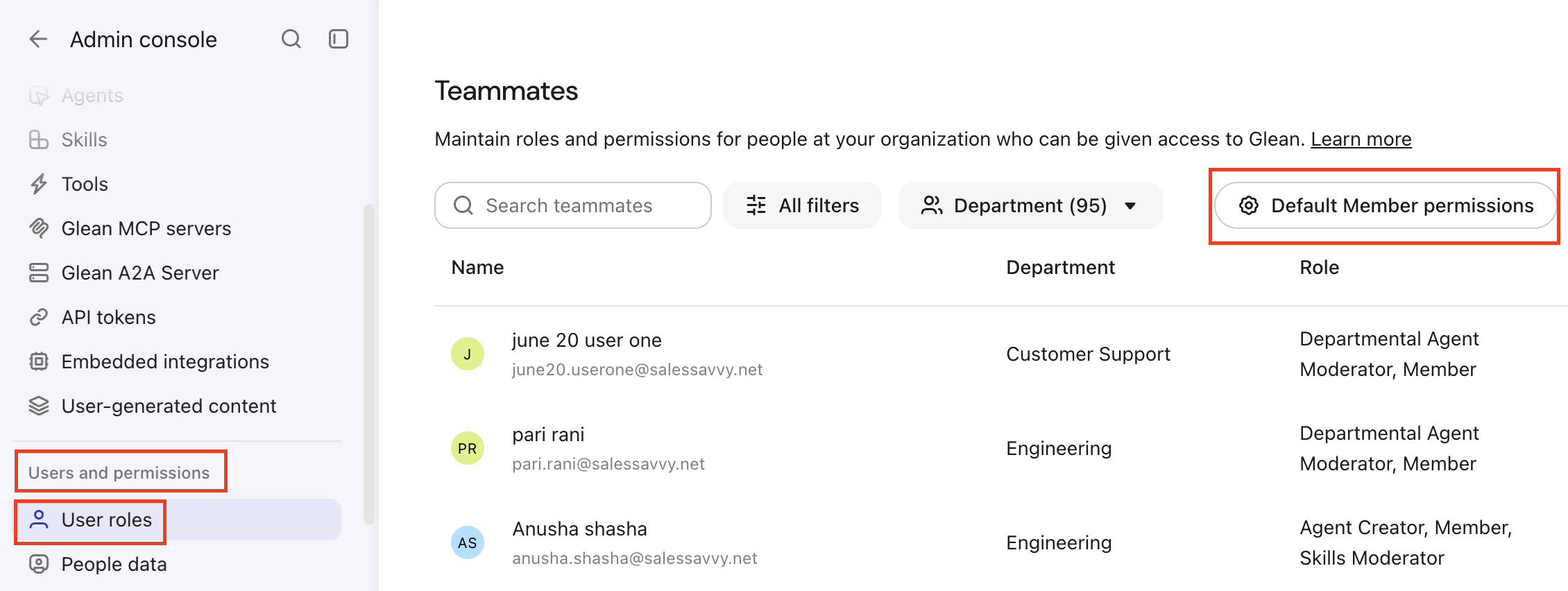
Available permission settings
These permission toggles operate independently. Disabling one setting does not impact the others.
| Permission toggle | Default state | What it controls |
|---|---|---|
| Can create and publish agents | On | Allows default members to create new agents and publish updates to existing shared agents. |
| Can publish agents via embedding, API, and Slack | Off | Allows members to deploy agents to external channels, including embedded widgets, the API, or Slack. |
| Can share agents | On | Allows members to share their owned agents with other users. |
Agent sharing scope options
When Can share agents is enabled, choose one of the following scope levels:
- Department only: Members can share agents exclusively with teammates in their own department.
- Include identity groups user is a member of: Check this box to extend sharing access to identity provider (IdP) groups that the user belongs to.
- Entire company: Members can share agents with anyone in the organization.
- Include all identity groups: Check this box to extend sharing access to every configured IdP group across the company.
The identity group checkbox displays only when group-based sharing is enabled. If no IdP groups are configured, an empty state is shown. Configure IdP groups under Admin console → Agents → Manage. For provider setup and group-picker behavior, see Share agents with identity provider groups.
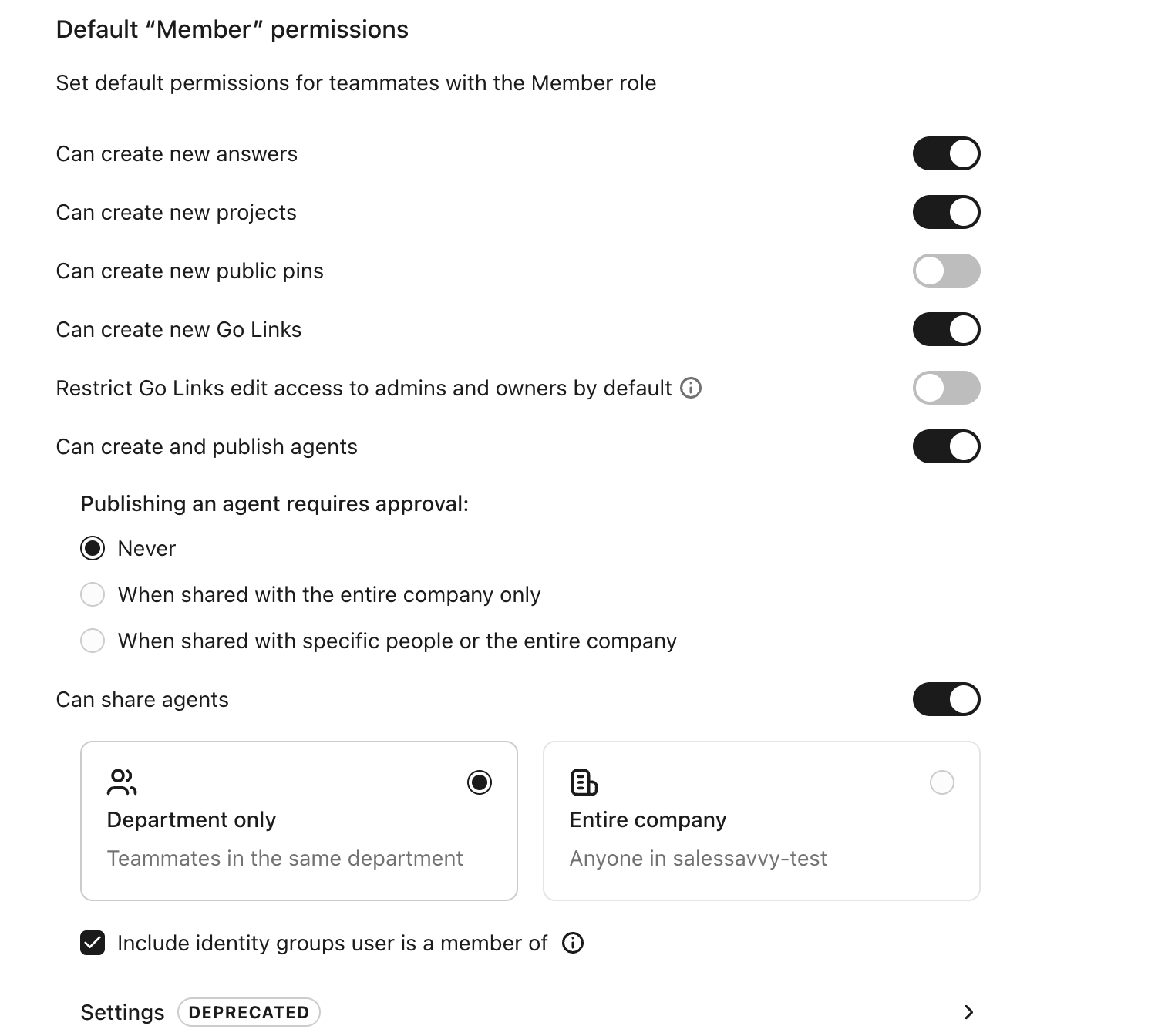
Publishing approval rules
Publishing approval is configured independently under Publishing an agent requires approval. Select one of three approval modes:
- Never: Users with publishing permissions can publish changes directly without approval.
- When shared with the entire company only: Changes require moderator review only if the agent is shared company-wide.
- When shared with specific people or the entire company: Changes require moderator review for any shared agent (including agents shared with specific individuals).
Approval workflow
When an approval rule is active:
- Agent builders submit a request to publish their updates.
- Agent moderators or department agent moderators review and publish the staged version.
Access level assignment rules
When an agent is shared, an editor can assign Viewer or Editor access levels to other users. Departments and identity provider groups can't receive Owner access.
- Transferring ownership: Restricted exclusively to the current owner, Agent Moderators, and Admins. The previous owner becomes an Editor after the transfer.
Assign agent roles
Admins can assign agent roles to any user:
- Navigate to Admin console → Users and permissions → User roles.
- Select the context menu for the user you want to assign an agent role to.
- Click Edit roles to open the Edit role dialog.
- For the Additional roles section, select the agent roles you want to add:
- Agent Creator
- Agent Moderator
- Departmental Agent Moderator (Select at least one department)
- Click Save to apply the changes.