Using the Glean MCP Server
This page helps end users connect supported MCP host applications to Glean and understand what they can do once connected.
What is MCP?
The Model Context Protocol (MCP) lets AI apps ("hosts" like Cursor, Claude, ChatGPT) securely connect to company tools and data. Glean provides an MCP server so your AI can use Glean’s permission-aware knowledge graph directly in those apps.
Glean tools available through MCP
Once connected, a host can call Glean's built-in tools, Glean agents, and external tools brought in through the Glean MCP Gateway. Glean's built-in tools include search, chat, document retrieval, code search, and people lookup.
When your admin adds the matching toolset, a host can also save content to your Library, update and share artifacts, and generate images. The exact set of tools available depends on your Glean configuration and the connecting host.
To bring existing Canvas content into an MCP host or save changes back to Glean, see Use Canvas content with MCP. To save content a host produces to your Library, see Save artifacts to your Library with MCP. To create and edit images from a host, see Generate images with MCP.
Use skills through MCP
An administrator must add the Dynamic skills and tools managed toolset (a prepackaged set of MCP tools) to the MCP server you use. Once the toolset is available, your MCP host can discover Glean Skills when it needs them instead of loading the full tool catalog at the start of a session.
The host starts by calling find_skills to find Glean Skills that match the request. Depending on the response, the host can call read_skill_files to read additional Skill files. When the selected Skill needs to use a connected tool, the host calls run_tool.
find_skillsfinds Glean Skills that match the request.read_skill_filesreads additional files when the response does not include the content the host needs.run_toolruns a connected tool when the selected Skill needs one.
This flow lets the host load the relevant Skill content and tools only when it needs them. If the toolset is not available on your server, ask your administrator to add it in the server settings.
If you're building an LLM-based application instead of using an MCP host, the Glean MCP server is a good fit when you want tool-based access to capabilities such as search, chat, and document retrieval. For direct, programmatic access to Glean beyond these tools, use the Glean REST APIs. For guidance on choosing between these interfaces, see Choose the right Glean interface.
MCP Configurator
Before the MCP Configurator is available, a Glean Administrator must enable at least one Glean MCP server.
You can open the MCP Configurator for setup instructions tailored to your host:
Access the MCP Configurator
The MCP Configurator gives you connection instructions, configuration snippets, and OAuth setup for each host.
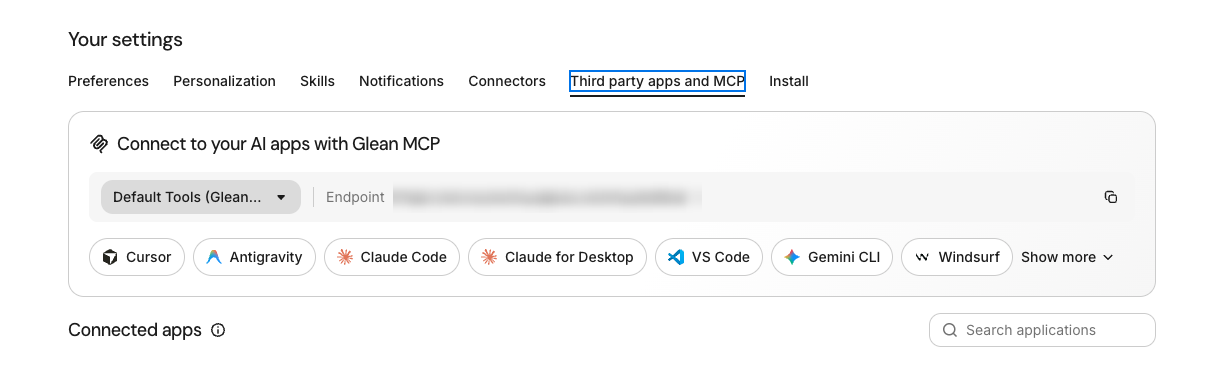
To access: Select your profile icon → Your settings → Third party apps and MCP tab → Connect to your AI apps with Glean MCP card. Or go straight to app.glean.com/settings/connected-apps.
Prerequisites
A Glean administrator must enable at least one Glean MCP server before the MCP Configurator is available. See the Administrator MCP Server Setup Guide.
How to install via MCP Configurator
Follow these steps to connect your AI app to Glean's MCP server. Each host gets its own setup instructions and server URL.
Open the connect card
To find the connect card:
- Select your profile icon in the lower-left corner of the home page
- Select Your settings
- Go to the Third party apps and MCP tab
- Find the Connect to your AI apps with Glean MCP card
Choose a server
Most people can keep the default server, which is marked recommended. If your organization has more than one server, pick the one you need from the server dropdown. The card shows the server's URL with a copy button.
Pick your host and set up the connection (optional)
Selecting a host from the list is optional. If you've copied the server URL, you can set up any host with it directly. To get setup instructions tailored to your app, select it from the host list (for example, Cursor, VS Code, or Claude Desktop). Select Show more to see the rest of your available hosts.
A setup window opens for your host. Choose the method that fits:
- Quick Setup: a one-click install for hosts that support it, such as Cursor
- CLI Command: a command you run in your host's terminal
- Manual Config: copy the server URL or configuration and paste it into your host's MCP settings
If your admin manages setup for a host, you'll see an Administrator Setup Required panel with the server URL instead.
Sign in to Glean
Complete sign-in with your organization's SSO when prompted. Your host then receives the OAuth tokens it needs to reach Glean's MCP server.
Verify the connection
Ask your assistant to “Search Glean for …” or “Read this document in Glean …” to confirm the connection works.
mcp-remote) to reach Glean's remote HTTP MCP server.Manage your connected apps
The Third party apps and MCP tab also lists every app you've authorized to access Glean on your behalf. That includes MCP hosts and other apps you've signed into with Glean. Apps are grouped by name, and for each one you can see the access you granted, when it expires, and when it was last used.
To review or remove an app:
- Go to Your settings → Third party apps and MCP.
- Find the app, then select it to see the access you granted.
- To disconnect it, select Revoke. The app loses access to Glean right away.
Supported hosts
Antigravity
Antigravity CLI
ChatGPT
Claude Code
Claude for Desktop
Claude for Teams/Enterprise
Codex
Cursor
Cursor Agent
Cursor Team MCP Servers
Gemini CLI
Gemini Enterprise
Gemini Agents
Goose
JetBrains AI Assistant
Junie (JetBrains)
LibreChat
Linear
Microsoft Copilot Studio
OpenCode
VS Code
Windsurf
We also support other MCP-compatible applications that are not listed here. You'll typically configure these applications using the URL of your Glean MCP server, for example https://{your-backend-domain}/mcp/[your-mcp-server-name]. Find your backend domain at app.glean.com/admin/about-glean under Server instance (QE). It typically follows the pattern company-be.glean.com, but may be different if your organization uses a custom domain.
Glean plug-in for Cursor, Claude Code, and Codex
If you use Cursor, Claude Code, or Codex, you can install a Glean plug-in for dynamic skill and tool discovery. Your existing permissions, connector access, tool visibility, and skills access still apply.
You can use the plug-in alongside a standard Glean MCP connection. Glean uses the connection best suited to each request.
Examples by Role
Looking for specific examples of what you can do with Glean's MCP server? Check out our role-based guides with real prompts you can use:
Engineering
Debug errors, review PRs, understand code history
Product Management
Draft PRDs, track projects, analyze feedback
Support
Triage tickets, find solutions, draft responses
Sales
Research accounts, prepare for calls, track deals
Data Analytics
Query databases, identify trends, generate reports
Operations
IT troubleshooting, HR policies, meeting prep
Troubleshooting
Assistant not using Glean?
- Be explicit: “Use Glean to …”
- Check the host is connected via the Configurator
Missing results or context?
- Verify the relevant connectors are enabled
- Remember: results respect your permissions in Glean
Host-specific issues?
- Some hosts require bridges (for example, stdio via mcp-remote) or have limited tools. See host setup guides from the Supported hosts section
Tips for effective prompts
To help your AI assistant choose the right tools, be explicit about the tool and input:
- "search Glean for …" when you need enterprise search
- "fetch the document …" when you have a URL or ID
See general guidance on tool selection patterns in your host's documentation.